
 EN
EN
Superior Acoustic Performance of Pet Acoustic Wall Panel
NRC Ratings and Measured Noise Reduction in Offices, Homes, and Restaurants
Modern interiors demand spaces that balance aesthetics with acoustic comfort. Pet acoustic wall panels deliver exceptional sound absorption, as evidenced by their Noise Reduction Coefficient (NRC). Independent testing shows that dense PET felt panels (12–24 mm thick) achieve NRC ratings between 0.80 and 0.95—absorbing 80–95% of incident sound energy across the critical speech frequency range (250–4000 Hz). In a typical open-plan office, applying PET panels to just 20–30% of reflective surfaces can cut reverberation time by up to 50%, transforming a noisy, fatiguing environment into a productive workspace. A 2023 study of a 200-seat restaurant found that installing 15 mm PET panels on 30% of wall area reduced background noise by 6 dB(A) and increased speech intelligibility scores by 25%. In residential settings—such as home theaters—strategic placement on rear walls and ceilings dampens echoes without over-deadening the room, enhancing immersion. This performance extends to retrofits: lightweight PET panels deliver measurable acoustic improvements quickly in existing spaces. Their porous, thermally bonded fiber structure dissipates sound energy as heat through friction, targeting mid-to-high frequencies where human speech and ambient noise concentrate—making them a practical, high-performance solution for offices, homes, and restaurants alike.
Why PET Felt Excels in Mid-to-High Frequency Absorption vs. Traditional Materials
PET felt’s acoustic superiority stems from its engineered fiber matrix. Unlike traditional foam or mineral wool, it consists of thermally bonded polyester fibers that form a dense, open-cell structure optimized for mid-to-high frequencies (500 Hz–4 kHz)—the dominant range of speech and office chatter. Conventional acoustic foam absorbs strongly at high frequencies but often underperforms in the mid-range; mineral wool offers broader absorption but requires encapsulation for safety and adds significant weight. The table below compares indicative absorption at 1 kHz for a 25 mm sample:
| Material (25 mm) | Typical Use | Absorption at 1 kHz (indicative) |
|---|---|---|
| PET Felt Panel | Walls, suspended panels | High (0.85–0.95) |
| Acoustic Foam Tile | Studios, booths | Medium–High (0.70–0.85) |
| Wood Slat + PET Composite | Feature wall panel | Medium–High (0.65–0.80) |
Values vary with density, thickness, and mounting air gap. PET felt maintains consistent performance across the speech band and retains structural integrity when cut or shaped—ideal for treating “talk zones” in offices, classrooms, and hospitality venues. Installing panels with an air gap behind them further enhances low-frequency absorption, helping mitigate bass buildup in open-plan environments. This balanced profile tames distracting reflections while preserving natural room character—giving designers a predictable, versatile tool to fine-tune intelligibility and ambiance.
Design Flexibility and Aesthetic Appeal of Pet Acoustic Wall Panel
Custom Color, Texture, and 3D Form Options for Contemporary Interiors
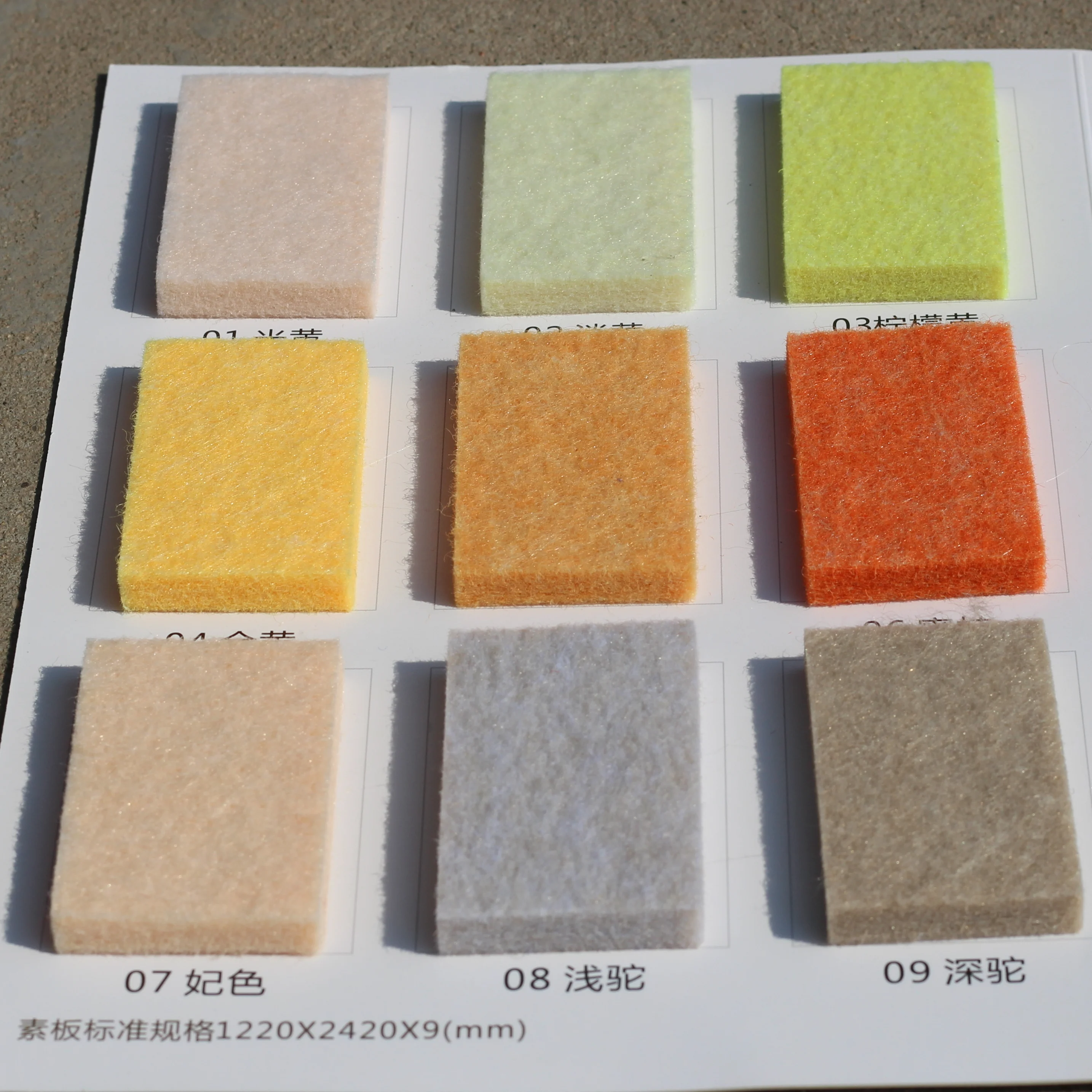
Pet acoustic wall panels transcend functional acoustics to become integral design elements. Unlike rigid fiberglass or foam, PET felt is manufactured in virtually any color—from deep, saturated hues to soft, natural tones mimicking wool or stone—enabling seamless integration into monochromatic schemes or bold, contrasting statements. Surface texture is equally controllable: options span ultra-smooth minimalism to deeply ribbed, felted, or embossed finishes, adding tactile warmth that softens hard-edged architecture. Its thermoformable nature allows precise creation of three-dimensional forms—waves, pyramids, hexagons, and organic undulations—that transform flat walls into dynamic, sculptural installations. These 3D configurations enhance sound diffusion while introducing shadow play and visual depth, highly valued in contemporary offices, high-end retail, and hospitality. As noted in a 2023 industry report, over 70% of commercial interior designers now prioritize customizable acoustic solutions—and few materials match the morphological freedom of PET felt. This capacity to tailor color, texture, and form ensures each installation supports—not disrupts—the space’s design narrative.
Printability and Bespoke Shape Fabrication for Residential and Creative Spaces
PET felt’s compatibility with high-resolution digital printing and precision CNC cutting unlocks unprecedented personalization. Residential users and creative agencies can commission panels printed with original artwork, nature photography, or branded graphics—turning functional acoustic treatment into expressive wall art. Its porous surface accepts UV-cured inks without compromising sound absorption, yielding vivid, durable imagery built for long-term use. Beyond flat prints, bespoke fabrication enables custom silhouettes—company logos, abstract geometries, or hand-drawn profiles—that are impractical or impossible with traditional acoustic materials. Lightweight and easy to handle, these made-to-order shapes install seamlessly as clustered compositions or singular accent pieces in home theaters, recording studios, or co-working lounges. The convergence of printability and freeform fabrication empowers architects and homeowners to align acoustic performance with deeply personal aesthetics—ensuring every installation reflects the identity of the space.
Sustainable Credentials Driving Adoption of Pet Acoustic Wall Panel
Today’s interior designers and architects increasingly prioritize materials that reconcile high performance with environmental responsibility—and pet acoustic wall panels sit squarely at this intersection. Manufactured primarily from post-consumer recycled plastic bottles, they typically contain 60% or more recycled content (2023 industry data), diverting waste from landfills while delivering NRC ratings up to 0.90. Their low-VOC, GREENGUARD Gold certified construction supports healthier indoor air quality and contributes directly to LEED and WELL Building Standard credits. Advanced fire-rated models meet B-s1,d0 classification under EN 13501-1 without halogenated flame retardants—fulfilling stringent safety requirements while upholding sustainability mandates. This holistic eco-profile—spanning circularity, resource efficiency, and reduced embodied carbon—has cemented PET panels as a default choice for high-performance, green-certified commercial interiors.
Practical Installation and Adaptive Use Cases for Pet Acoustic Wall Panel
Beyond acoustic and aesthetic strengths, pet acoustic wall panels excel in real-world deployment. Their adaptive design suits diverse interior environments—from hospitality to creative workspaces—with field-cuttable, lightweight, and modular construction simplifying installation in hotels and studios.
Field-Cuttable, Lightweight, and Modular: Simplified Deployment in Hotels and Studios
PET acoustic wall panels feature a semi-rigid, lightweight structure that is easy to handle and install. Installers can cut them on-site using standard tools—including utility knives or CNC routers—with melted edges re-fusing cleanly for professional finishes. This field-cuttable capability eliminates the need for exact pre-fabrication, reducing lead times, material waste, and labor costs. Modular sizing and versatile mounting options—including construction adhesive, screws, or concealed rail systems—support flexible layouts and future reconfiguration. In hotels, panels install quickly in corridors and lobbies without disrupting guest operations, maintaining both acoustic privacy and design continuity. In studios, non-invasive, reversible mounting allows rapid adaptation to evolving recording needs—optimizing sound control without permanent structural changes.
FAQ
What is the NRC rating of PET acoustic wall panels?
PET acoustic wall panels achieve NRC ratings between 0.80 and 0.95, meaning they absorb 80–95% of incident sound energy.
Are PET panels suitable for residential use?
Yes, they are ideal for residential settings such as home theaters, where they enhance immersion and sound quality without over-deadening the room.
How do PET panels compare to traditional acoustic materials?
PET panels outperform traditional materials like foam or mineral wool in absorbing mid-to-high frequencies, essential for speech clarity.
Are PET panels customizable?
Absolutely, PET panels offer options for color, texture, 3D forms, and even high-resolution printing for personalized designs.
Are PET panels eco-friendly?
Yes, PET panels are made from post-consumer recycled materials, are low-VOC, and contribute to green building certifications.