
 EN
Acoustic Performance: Targeted Absorption for Pet-Friendly Environments
NRC Ratings and Mid-to-High Frequency Absorption (100–4000 Hz) for Barking, Meowing, and Play Noise
A pet acoustic wall panel’s core purpose is to manage the distinct sonic profile of animal companions—sharp barks (500–1,000 Hz), high-pitched meows (700–800 Hz), and the rapid clicks of claws on hard floors. The Noise Reduction Coefficient (NRC) quantifies this capability: it measures average sound absorption across 250–2000 Hz, with scores ranging from 0 (fully reflective) to 1 (fully absorptive). Top-tier panels achieve NRC values between 0.75 and 0.95—meaning they absorb up to 95% of incident mid-to-high frequency energy. This directly reduces reverberation, lowers overall noise levels, and creates calmer environments for both pets and people. While NRC doesn’t capture performance below 250 Hz or above 2000 Hz, it remains the most widely accepted, standardized metric for evaluating real-world speech- and pet-noise control.
Realistic Low-Frequency Limits and the Role of Thickness, Air Gap, and Mounting in Pet Acoustic Wall Panel Efficiency
Porous PET panels inherently struggle with low-frequency sounds—like the rumble of a large dog’s bark or footfall resonance—due to the physics of air movement through fiber matrices. Their absorption rolls off significantly below 250 Hz. However, this limitation is addressable through design and installation—not material replacement. Increasing panel thickness from 9 mm to 24 mm extends effective absorption downward by improving internal path length for longer wavelengths. More impactfully, mounting the panel with a 40–50 mm air gap behind it transforms it into a resonant bass trap, shifting peak absorption toward 100–150 Hz. When combined, greater thickness and an optimized air cavity create a balanced, integrated system that manages both the piercing highs of vocalizations and the thumping lows of movement—without requiring hybrid constructions or added membranes.
Material Integrity: Recycled PET Density, Consistency, and Structural Stability
Recycled PET Purity, Fiber Length, and Compression Density’s Impact on Durability and Sound Absorption
The acoustic and structural performance of a pet acoustic wall panel begins with its recycled PET (rPET) feedstock. High-purity input—free of PVC, adhesives, labels, and contaminants—ensures uniform fiber formation and consistent bonding. Fiber length (typically 40–70 mm in nonwoven acoustic felts) governs entanglement density: longer fibers yield a more resilient surface that resists claw pulls, pilling, and abrasion from active pets. Compression density—the mass of fiber per unit volume (100–300 kg/m³)—directly influences airflow resistivity and absorption efficiency. Data from Xometry (2024) confirms PET’s inherent material density (1.33–1.40 g/cm³), but panel density reflects engineered compaction. Raising density from 100 to 200 kg/m³ typically increases NRC by 10–15% in the 500–2000 Hz range—precisely where barking and meowing dominate. Beyond 250 kg/m³, however, excessive compression can reduce porosity and impair low-frequency absorption while increasing surface reflectivity. Uniform thermo-bonding ensures consistent density throughout the panel, eliminating internal voids that compromise both acoustic predictability and long-term physical stability.
Edge Rigidity, Humidity Resistance, and Dimensional Stability for Long-Term Use in Pet Acoustic Wall Panel Installations
In pet-centric spaces—from grooming salons to multi-pet homes—panels face humidity swings, accidental impacts, and constant contact. PET’s natural hydrophobicity is a key advantage: per ISO 62, its water absorption remains under 0.8%, preventing swelling, mold growth, or degradation near aquariums or wet zones. Edge rigidity is equally vital; panels with thermo-compressed, sealed edges resist fraying, fiber shedding, and snagging—critical when pets brush past or nudge walls. Dimensional stability must meet rigorous benchmarks: high-performance panels exhibit less than 1% linear expansion after 48 hours at 90% relative humidity and 40°C (ASTM D5229). This ensures flatness, secure mounting, and sustained acoustic alignment over years of use. Paired with impact-resistant fiber matting, these attributes allow panels to retain integrity amid daily wear—no warping, no delamination, no loss of performance.
Pet-Safe Durability and Indoor Environmental Health
Non-Toxicity, Impact Resistance, and Easy Cleanability for High-Traffic Pet Spaces
Safety is non-negotiable. Because pets lick, chew, and rub against surfaces, panels must be certified free of heavy metals, formaldehyde, phthalates, and other hazardous plasticizers. Impact resistance ensures longevity: dense, compressed PET cores withstand repeated bumps from dogs and scratches from cats far better than open-cell foams or loosely bonded felts. Cleanability is practical necessity. Fur, dander, saliva, and occasional accidents require surfaces that repel moisture and wipe clean with a damp cloth—no absorption, no staining, no odor retention. Scrub-resistant finishes maintain appearance and hygiene over time, supporting both aesthetics and health in high-traffic pet environments.
Low-VOC Emissions, Moisture Management, and Microbial Resistance per ASTM Standards
Indoor air quality is especially critical for pets, whose respiratory systems are more sensitive than humans’. Panels certified to ASTM D5116 demonstrate negligible VOC emissions post-installation—ensuring safe, breathable air for animals and owners alike. Effective moisture management prevents hidden deterioration: rapid drying after incidental exposure halts mold initiation, preserving structural and acoustic function. Microbial resistance, verified per ASTM E2180, confirms the surface inhibits bacterial and fungal colonization—a crucial safeguard in humid, high-dander settings like kennels or cat rooms.
Design and Installation Practicality for Real-World Pet Acoustic Wall Panel Applications
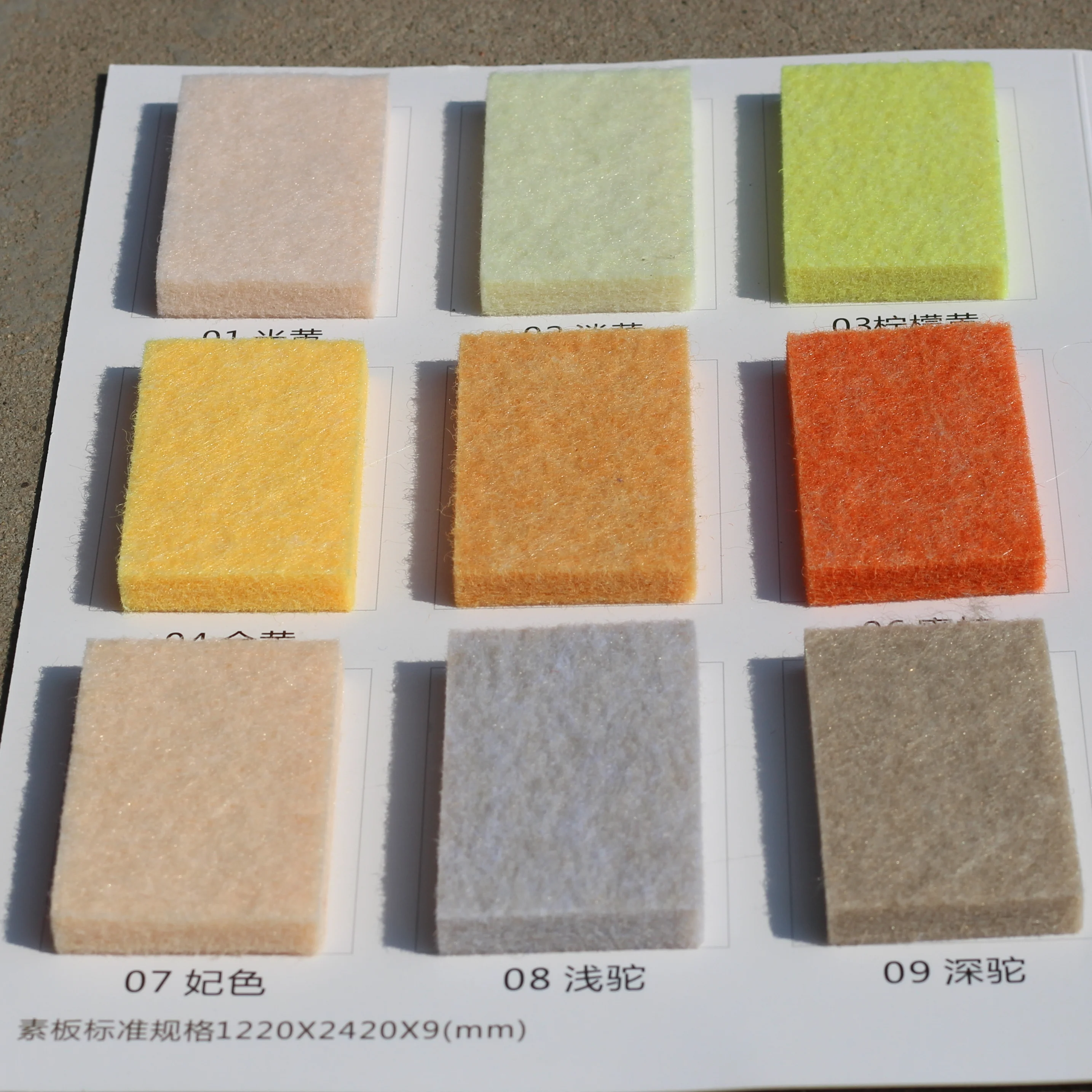
Practicality determines real-world success. A panel may perform acoustically but fail if it’s difficult to cut, mount, or maintain in a home with pets. Modular designs—cuttable, bendable, and spliceable on-site—enable precise adaptation to doorways, corners, and irregular walls. Lightweight construction (typically 2–4 kg/m²) reduces load on walls and ceilings, making overhead or partial installations safer and simpler. Rich, matte color palettes and textured surfaces hide minor scuffs, fur accumulation, and light scratching—blending seamlessly into residential or commercial interiors without drawing attention to wear.
Installation should be intuitive and secure. Most high-performing panels use either high-tack construction adhesive or z-clip systems for tool-free, removable mounting. Surface prep is minimal: clean, dry, and dust-free. Fasteners—when used—must be fully recessed or concealed to prevent paw snags. A snug, gap-free fit not only improves acoustic continuity but also blocks dander and hair from migrating behind the panel. Once installed, the panel stays firmly in place—even under playful nudges or energetic leaps—delivering lasting performance, safety, and visual cohesion in dynamic pet environments.
Frequently Asked Questions (FAQ)
What is an NRC rating?
An NRC (Noise Reduction Coefficient) rating measures the sound absorption capability of a material, ranging from 0 (fully reflective) to 1 (fully absorptive). It’s particularly useful for evaluating panels that reduce pet noise like barking and meowing.
Can pet acoustic wall panels manage low-frequency sounds?
Yes, though they have inherent limitations. Enhancing thickness and adding an air gap during installation can improve absorption of low-frequency sounds like deep barking or footfall resonance.
Are pet acoustic wall panels safe for animals?
Yes, they are designed to be non-toxic, free from harmful chemicals like heavy metals and formaldehyde, ensuring safety even if pets lick or chew them.
How do I clean pet acoustic wall panels?
These panels are easy to clean with a damp cloth, as they resist moisture, staining, and odor retention.
Do pet acoustic wall panels emit chemicals into the air?
No, most panels meet ASTM standards for low-VOC emissions, ensuring a safe indoor environment for pets and humans alike.
Are they easy to install?
Yes, pet acoustic wall panels are lightweight and can be mounted with adhesives or z-clip systems. They are customizable for various spaces and easy to secure in place.
Table of Contents
- Acoustic Performance: Targeted Absorption for Pet-Friendly Environments
- Material Integrity: Recycled PET Density, Consistency, and Structural Stability
- Pet-Safe Durability and Indoor Environmental Health
- Design and Installation Practicality for Real-World Pet Acoustic Wall Panel Applications
- Frequently Asked Questions (FAQ)